
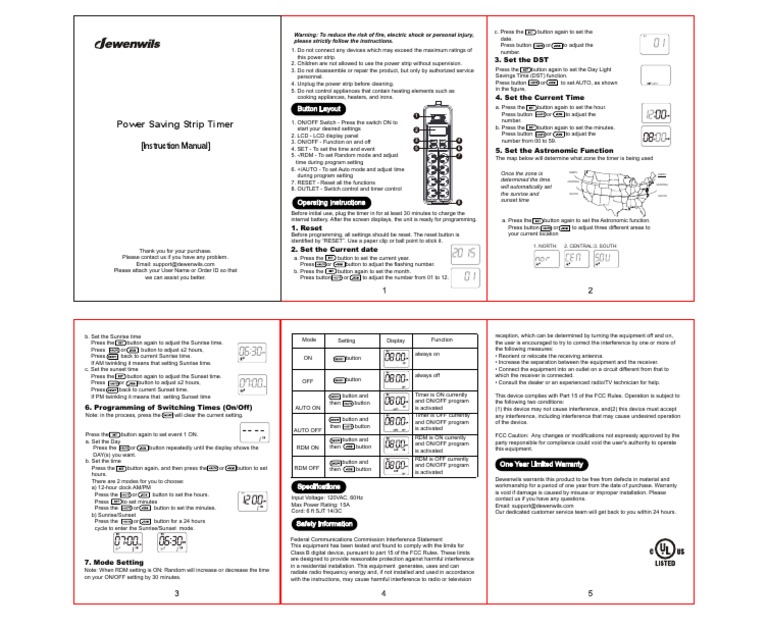

The question of whether you can plug a timer into a power strip is one that often arises among home and office users seeking to automate their electrical devices. Understanding the nuances of both power strips and timers is essential for safe and efficient use. Let’s delve deep into the intricacies of these two devices, their compatibility, and how they can be utilized effectively in various scenarios.
To begin with, it is paramount to understand what a timer and a power strip are. A timer, in essence, serves as a programmable switch that turns electrical devices on and off at predetermined intervals. This can be particularly beneficial for lamps, fans, or other appliances that you wish to control remotely or on a set schedule. Power strips, on the other hand, are designed to extend the number of outlets available from a single wall socket, effectively allowing multiple devices to draw power simultaneously.
Now, the primary inquiry: can you connect a timer to a power strip? The short answer is: yes, you can typically plug a timer into a power strip. However, the situation is not devoid of caveats. There are several factors to consider before proceeding, especially in terms of safety and functionality.
Understanding Power Ratings
Before any connection is made, one must consider the electrical ratings of the timer and power strip. Each device will have a specified maximum wattage or amperage that it can handle. When plugging a timer into a power strip, it is essential to ensure that the combined power draw of all plugged-in devices does not exceed the power strip’s rating. Exceeding this limit can lead to overheating and potential fire hazards.
Types of Timers
There are various types of timers available on the market: mechanical, digital, and smart timers. Mechanical timers are the most basic, typically offering a dial where users can set the on/off times. Digital timers provide more precise control and may even offer multiple on/off programs. Smart timers take automation a step further, allowing for control through smartphone apps or voice commands.
When choosing a timer to pair with a power strip, consider the type that best meets your needs. For instance, a mechanical timer is simpler but may not provide the versatility that a digital or smart timer does. However, when integrated into a power strip, ensure it can still handle the cumulative load.
Considerations Regarding Safety
Safety should always be paramount. When plugging a timer into a power strip, check for any visible damage or wear on both devices. Cracked casings or frayed wires can introduce significant risks. Furthermore, it is crucial to avoid daisy-chaining multiple power strips or timers, as this creates an undue electrical load that severely increases the risk of malfunction.
For appliances that draw significant power—like heaters or large kitchen appliances—are particularly susceptible to these issues. If using such a device, relying directly on a wall outlet is recommended, rather than chaining it through a power strip, and further through a timer.
Real-world Applications
The practical applications of using timers with power strips are vast. For instance, in a home setting, one might use a timer connected to a power strip to control the lights of an entire room, creating an illusion of occupancy when away. This simple automation can enhance home security by deterring potential intruders.
In an office environment, the integration of timers with power strips can facilitate energy conservation. Powering down equipment, such as printers or coffee machines, after hours reduces energy consumption and prolongs the lifespan of devices. Moreover, combined with smart timers, remote monitoring of appliance schedules becomes a breeze—allowing for utmost efficiency.
Technological Innovations
As technology continues to advance, timers and power strips are evolving as well. Smart home technology allows synchronization between multiple devices. For example, one may set up a smart timer plugged into a power strip that operates multiple lamps or appliances based on external conditions like sunlight or temperature. This adaptability offers convenience, sustainability, and flexibility in managing home or office environments.
Alternative Solutions
If concerns about safety and efficiency loom large, alternative solutions exist. Smart plugs, which directly connect to a wall outlet, often offer built-in timer functionalities without the need for additional power strips. This compact solution can simplify setups and reduce the need for multiple devices while maintaining the desired automation and control.
Conclusion
In conclusion, plugging a timer into a power strip is generally permissible, but it necessitates a careful consideration of various factors, including power ratings, types of devices, and safety precautions. By understanding the underlying principles and applications of timers and power strips, one can effectively use them to enhance convenience and security in any environment. As automation becomes increasingly integral to modern life, embracing it through thoughtful implementations can lead to profound improvements in both comfort and efficiency.
