
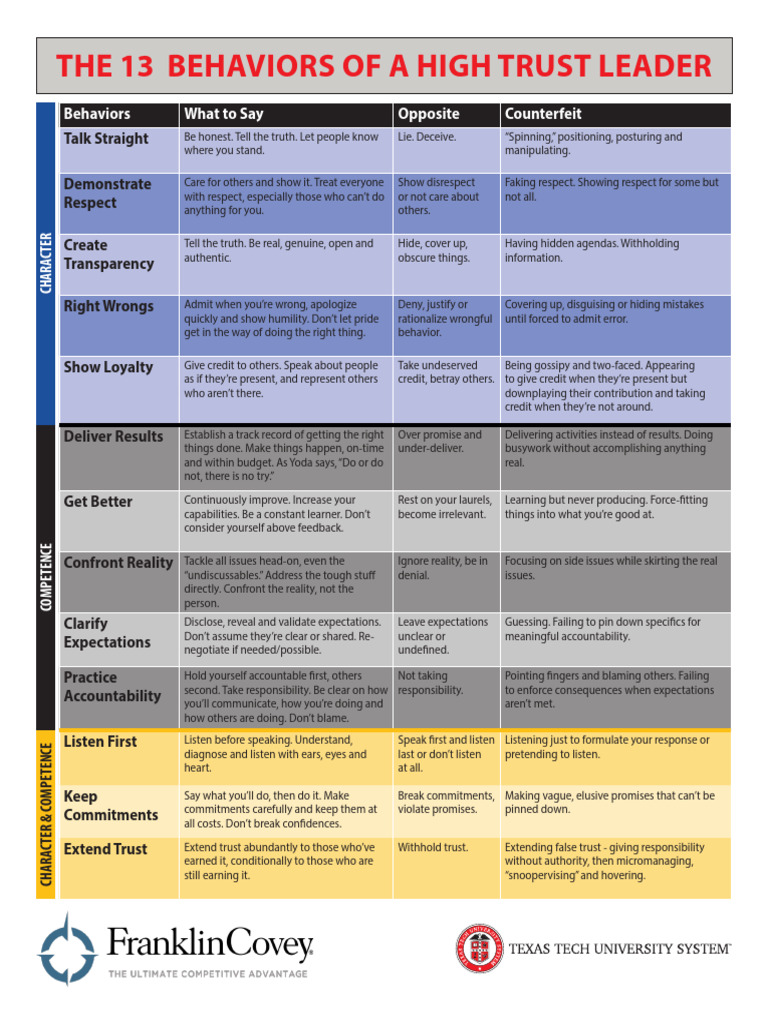

In a world that often feels divided by conflicting interests and divergent values, the notion of trust becomes paramount, especially within leadership. High-trust environments are not merely beneficial; they are essential for the flourishing of organizations and communities alike. The construction of such environments hinges on specific behaviors exhibited by leaders—those who have mastered the art of cultivating trust with their teams and stakeholders. Let’s delve into the 13 behaviors that define high-trust leaders, illuminating how these characteristics foster collaboration and innovation.
First and foremost, high-trust leaders are profoundly authentic. They project a sense of genuineness that resonates deeply with their teams. Rather than adopting a façade of perfection, they embrace vulnerability, acknowledging their flaws and limitations. This authenticity fosters a culture where team members feel safe to express their own imperfections, ultimately nurturing an atmosphere rich in acceptance and understanding.
Equally important is the trait of transparency. High-trust leaders keep communication channels wide open, ensuring that information flows freely throughout the organization. By sharing insights into decision-making processes and the rationale behind strategic directions, leaders demonstrate their commitment to honesty. Transparency not only builds confidence but also mitigates the uncertainty that can often plague organizations, allowing for a more cohesive and united front.
Furthermore, effective communication transcends mere information sharing; it requires active listening. High-trust leaders engage with their teams by truly listening and valuing their input. This behavior not only reinforces the idea that every voice matters but also garners respect from team members. When leaders listen attentively, they gain valuable insights that can inform their decisions, thus propelling innovation and improvement.
In addition, high-trust leaders exhibit empathy. They possess an acute awareness of their team members’ emotional landscapes, recognizing that personal and professional lives are often intertwined. By understanding and validating feelings, these leaders create bonds that foster loyalty and commitment. Empathy deepens connections, enhancing collaboration and enabling teams to navigate challenges with greater resilience.
Accountability is another cornerstone of high-trust leadership. Leaders must not only hold their teams accountable but also be willing to take responsibility for their actions. When leaders model accountability, they set a standard, establishing a culture where team members feel empowered to own their contributions and mistakes. This leads to a more engaged workforce, willing to learn and grow from experiences.
High-trust leaders are also adept at providing constructive feedback. Instead of merely pointing out flaws, they approach feedback as an opportunity for growth. By focusing on strengths and offering guidance on improvement, these leaders foster an environment where learning is prioritized. Constructive feedback encourages continuous development, igniting a sense of purpose and motivation among team members.
Moreover, high-trust leaders demonstrate consistency in their actions and decisions. By adhering to their values and principles, they cultivate trust over time. Consistency reassures team members, reducing anxiety and fostering a feeling of security. When leaders are predictable in their behavior, it cultivates a sense of stability, allowing teams to focus on their work rather than navigating the unpredictable waters of leadership.
The behavioral repertoire of high-trust leaders includes a strong emphasis on inclusivity. By actively promoting diversity of thought and experience, these leaders create a rich tapestry of ideas. Inclusivity not only fosters creativity but also enhances problem-solving capabilities. When individuals from varied backgrounds come together, the collaborative synergy can lead to innovative solutions that are otherwise unattainable in a homogenous environment.
Equally vital is the leader’s ability to inspire and motivate. High-trust leaders possess a vision that transcends daily tasks; they inspire their teams by articulating a compelling narrative that aligns with shared values. This intrinsic motivation compels team members to invest their energy and creativity into achieving common goals. When individuals feel connected to a larger purpose, their dedication to the mission intensifies, leading to exceptional outcomes.
A critical, often overlooked component is the leader’s capacity for forgiveness. High-trust leaders understand that mistakes are an inherent aspect of growth. By adopting a forgiving approach, they not only alleviate the fear of failure but also encourage risk-taking and exploration. This willingness to let go of past grievances fosters a learning culture, where experimentation is celebrated rather than punished.
In addition, high-trust leaders exhibit a genuine commitment to professional development. They understand that the growth of their teams is integral to the organization’s success. By investing in training, mentorship, and career advancement opportunities, leaders signal their belief in the potential of their team members. This not only enhances skills but also cultivates loyalty and deepens trust in the leadership.
Lastly, high-trust leaders are visionaries who practice forward-thinking. They anticipate changes in their environment, proactively addressing challenges and opportunities. This forward-thinking mindset enables leaders to guide their teams through uncertainty, instilling confidence that they are equipped to navigate future landscapes collaboratively.
In conclusion, the behaviors of high-trust leaders are multi-faceted and interdependent. These leaders embody authenticity, transparency, active listening, empathy, accountability, and numerous other essential characteristics that build lasting bridges within their teams. The fascination surrounding these leaders lies not only in their impressive skill sets but also in their profound ability to cultivate environments rich in trust and innovation. As organizations aim to thrive in an increasingly complex world, the hallmark of high-trust leadership will undoubtedly stand as a beacon guiding them towards success.
